 亚新网站
亚新网站Release date:2021-06-11
Allergy
[IF:6.771]
Expanding the allergen repertoire of salmon and catfishDOI: 10.1111/ALL.14574
Abstract:
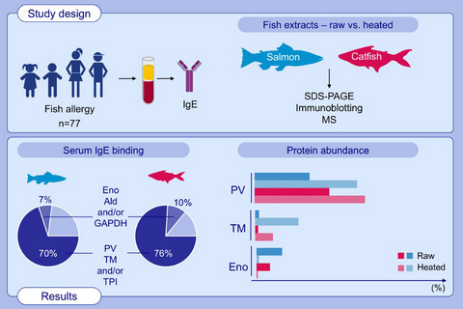
Background: Diagnostic tests for fish allergy are hampered by the large number of under-investigated fish species. Four salmon allergens are well-characterized and registered with the WHO/IUIS while no catfish allergens have been described so far. In 2008, freshwater-cultured catfish production surpassed that of salmon, the globally most-cultured marine species. We aimed to identify, quantify, and compare all IgE-binding proteins in salmon and catfish.
Methods: Seventy-seven pediatric patients with clinically confirmed fish allergy underwent skin prick tests to salmon and catfish. The allergen repertoire of raw and heated protein extracts was evaluated by immunoblotting using five allergen-specific antibodies and patients' serum followed by mass spectrometric analyses.
Results: Raw and heated extracts from catfish displayed a higher frequency of IgE-binding compared to those from salmon (77% vs 70% and 64% vs 53%, respectively). The major fish allergen parvalbumin demonstrated the highest IgE-binding capacity (10%-49%), followed by triosephosphate isomerase (TPI; 19%-34%) in raw and tropomyosin (6%-32%) in heated extracts. Six previously unidentified fish allergens, including TPI, were registered with the WHO/IUIS. Creatine kinase from salmon and catfish was detected by IgE from 14% and 10% of patients, respectively. Catfish L-lactate dehydrogenase, glyceraldehyde-3-phosphate dehydrogenase, pyruvate kinase, and glucose-6-phosphate isomerase showed IgE-binding for 6%-13% of patients. In salmon, these proteins could not be separated successfully.
Conclusion: We detail the allergen repertoire of two highly farmed fish species. IgE-binding to fish tropomyosins and TPIs was demonstrated for the first time in a large patient cohort. Tropomyosins, in addition to parvalbumins, should be considered for urgently needed improved fish allergy diagnostics.
First Author:
Thimo Ruethers
Correspondence:
Andreas L. Lopata; Pharmacy and Medical Research, Bldg. 47,1 James Cook Drive, James Cook University, Townsville, QLD 4811, Australia
All Authors:
Thimo Ruethers, Aya C. Taki, Shaymaviswanathan Karnaneedi, Shuai Nie, Tanja Kalic, Danyi Dai, Sakda Daduang, Michael Leeming, Nicholas A. Williamson, Heimo Breiteneder, Sam S. Mehr, Sandip D. Kamath, Dianne E. Campbell, Andreas L. Lopata
2021-06-11 Article
Hangzhou Zheda Dixun Biological Gene Engineering Co., Ltd. Copyright HZKC Technical support 浙ICP备14005341号 (浙)-非经营性-2019-0050
Address: Rm.201-209, Bldg.2, No.568 Binkang Rd., Binjiang Dist. Tel: 0571-87968248-805 Website:www.therealkc.com
COPYRIGHT©2003-2025 www.therealkc.com CORPORATION. ALL RIGHTS RESERVED


Official WeChat
开云手机登录入口 | 星空体育·(StarSky Sports)官方网站 | 云博app官方在线入口 | 江南平台 | 江南登录网站 | 开云官方注册 | 乐鱼在线登录最新官网(中国)官方有限公司 | 华球平台 | 开云网页版 |