 亚新网站
亚新网站Release date:2019-02-20
[IF:13.258]
Cesarean delivery, preterm birth, and risk of food allergy: Nationwide Swedish cohort study of more than 1 million children
DOI: org/10.1016/j.jaci.2018.06.044
Abstract:
Background:
Little is known about early-life risk factors for food allergy in children .
Methods:
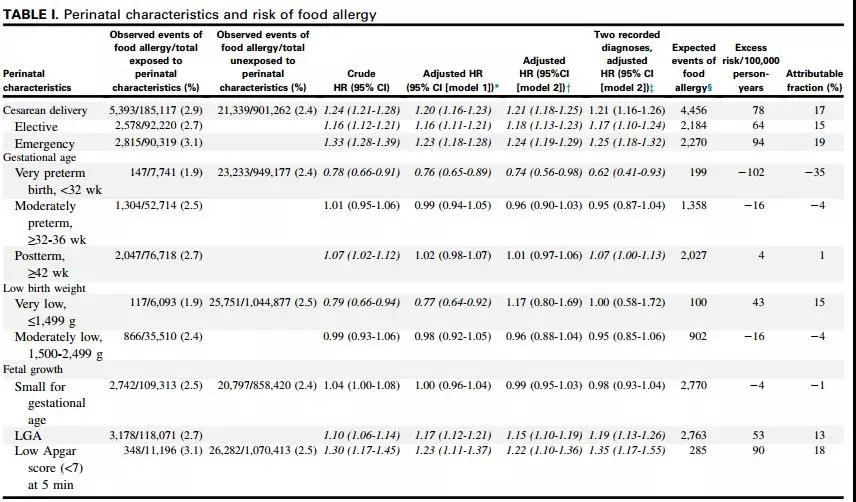
This nationwide Swedish cohort study of 1,086,378 children born in Sweden in 2001-2012 used prospectively recorded data from health care registers. Using Cox regression,we estimated hazard ratios (HRs) with 95% CIs for the association between perinatal characteristics (eg, cesarean delivery and preterm birth) and food allergy as defined by diagnoses in the National Patient Register, adjusting for infant sex and maternal factors (age at delivery, country of birth, parity, smoking, body mass index, and asthma/pulmonary disease).
Results:
During the 13-year follow-up, 26,732 (2.5%) children were given a diagnosis of food allergy. Food allergy was positively associated with cesarean delivery (HR, 1.21; 95% CI, 1.18-1.25), large for gestational age (HR, 1.15; 95% CI,1.10-1.19), and low 5-minute Apgar score (HR, 1.22; 95% CI, 1.10-1.36) but negatively associated with very preterm birth (<32 weeks of gestation: HR, 0.74; 95% CI, 0.56-0.98). No association was found between food allergy and moderately preterm birth, low birth weight, or small for gestational age.Risk estimates were similar when the outcome was restricted to 2 records of diagnosed food allergy. In 1,000 children undergoing cesarean delivery, an extra 5 developed food allergy compared with the reference group, suggesting that 17% of food allergy in children born by means of cesarean delivery can be explained by this exposure (attributable fraction).
Conclusions:
Cesarean delivery was associated with increasedrisk of food allergy, whereas very preterm birth decreased risk.
First Author:
Niki Mitselou
Correspondence:
Department of Pediatrics, Orebro University € Hospital, S€ odra Grev Rosengatan, Orebro 701 85, Sweden
All Authors:
Niki Mitselou, Jenny Hallberg, Olof Stephansson, Catarina Almqvist, Erik Melen, and Jonas F. Ludvigsson
2019-01-17 Article
Hangzhou Zheda Dixun Biological Gene Engineering Co., Ltd. Copyright HZKC Technical support 浙ICP备14005341号 (浙)-非经营性-2019-0050
Address: Rm.201-209, Bldg.2, No.568 Binkang Rd., Binjiang Dist. Tel: 0571-87968248-805 Website:www.therealkc.com
COPYRIGHT©2003-2025 www.therealkc.com CORPORATION. ALL RIGHTS RESERVED


Official WeChat
开云手机登录入口 | 星空体育·(StarSky Sports)官方网站 | 云博app官方在线入口 | 江南平台 | 江南登录网站 | 开云官方注册 | 乐鱼在线登录最新官网(中国)官方有限公司 | 华球平台 | 开云网页版 |